

What are ASA Snapshot Reports?
ASA Snapshot Reports provide a quick, data-driven view of how effectively the advertising rules are being followed across specific sectors.
They use insights from our AI-based Active Ad Monitoring system to measure compliance levels, highlight good practice, and identify emerging risks.
Overview
This Snapshot Report examines the compliance of “content marketing” posts published by licensed gambling operators on their own social media, between August 2025 and March 2026.
Where the content of these social media posts relates to an operator’s gambling services, either directly or through significant indirect references, the posts are likely to be directly connected with the supply of gambling services to consumers and therefore considered to be ads. The monitoring assessed whether these posts were marketing communications for the purposes of the CAP Code, and then for those that were ads within the ASA’s remit, whether they were likely to be compliant with the CAP Code’s gambling rules.
“Content marketing” is a term often used to describe posts published by operators that contain editorial-style content, like commentary or opinions on recent events, or more abstract humour, such as memes and other irreverent takes on current sporting news, where there are no direct product references, calls to action or links to operator websites. Researchers have raised concerns about content marketing posts in the past, and it's important that we understand whether content marketing that is classed as advertising is complying with the rules.
Findings
Our Active Ad Monitoring system captured 1,845 organic Instagram posts from 18 gambling operators. 190 of these were flagged as highly likely to be editorial. A further 890 were flagged as highly likely to be compliant. A representative sample of the remaining 765 posts were taken forward for expert review.
Compliance levels:
Of the social media posts on Meta that were assessed (388):
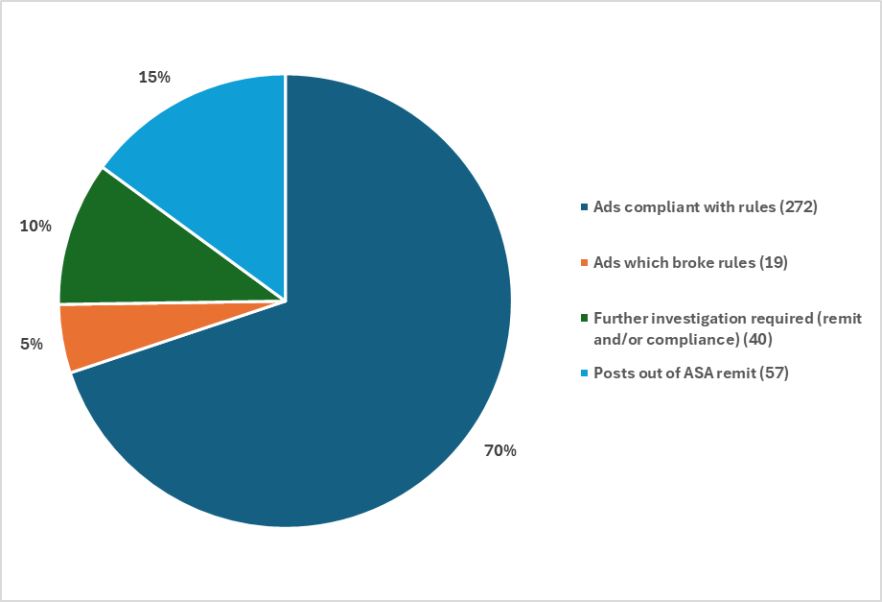
For those posts reviewed on X, as the sweep was done manually the number of posts being assessed couldn’t easily be tracked. It’s therefore not possible to give a percentage breakdown of compliance. However, of the 24 gambling operator accounts reviewed, five posts were identified as likely to be both (A) ads and (B) in breach of the CAP Code.
Non-compliant ads
We identified a small number of posts that were likely to be both ads and in breach of the rules. These posts mostly contained imagery related to high profile football clubs that didn’t conform to what’s allowed in the guidance which accompanies the strong appeal rule, and one such post was referred for formal investigation. The depiction of an individual likely to be of strong appeal to children also featured in one post. Where the posts we assessed were clearly non-compliant, we are taking action to address these, including our recently announced sector enforcement work. Any posts that were not ads – but would have been clearly problematic had they been ads – have been referred to the Gambling Commission.
Conclusion
Encouragingly, compliance in the sector is high. However, a few issues remain, and it is important these are addressed. This will be through a combination of rulings, where further precedent is needed, and wider follow up enforcement work. We will be sharing our findings with gambling operators, the Gambling Commission and platforms as part of our ongoing education and partnership working in this priority area of our work.
How did we carry out this monitoring?
- Using our Active Ad Monitoring system, we captured 1,845 organic Instagram posts from a list of 18 gambling operators.
- Using AI-based filtering, we screened out posts that were highly likely to be editorial or highly likely to be compliant, with the remaining posts left for manual review.
- We carried out two sweeps of gambling operators‘ organic social media posts on Meta, covering several months’ worth of content (August 2025 – March 2026). Combined, 765 posts were marked for manual review, of which a representative sample of 388 posts were assessed. Meanwhile, the Executive led a desk-based review of operator posts published on X (February – March 2026).
- We referred these posts to our experts to assess (a) whether they were likely to be marketing communications within the remit of the CAP Code, and then (b) compliance with the Gambling section of the advertising rules, with a focus on:
- 16.3 – [Gambling] Marketing communications must not:
- 16.3.12 – be likely to be of strong appeal to children or young persons, especially by reflecting or being associated with youth culture.
- They must not include a person or character whose example is likely to be followed by those aged under 18 years or who has a strong appeal to those aged under 18.
- Where appropriate steps have been taken to limit the potential for an advertisement to appeal strongly to under-18s, this rule does not prevent the advertising of gambling products associated with activities that are themselves of strong appeal to under-18s (for instance, certain sports or playing video games). CAP has published guidance on the application of the rule, including for advertising of gambling products associated with activities that are themselves of strong appeal to under-18s.
- 16.3.14 – include a child or a young person. No-one who is, or seems to be, under 25 years old may be featured gambling or playing a significant role. No-one may behave in an adolescent, juvenile or loutish way.
- Individuals who are, or seem to be under 25 years old (18-24 years old) may be featured playing a significant role only in marketing communications that appear in a place where a bet can be placed directly through a transactional facility, for instance, a gambling operator's own website. The individual may only be used to illustrate specific betting selections where that individual is the subject of the bet offered. The image or other depiction used must show them in the context of the bet and not in a gambling context.
- We are following up with enforcement action in this area. Those posts not within the ASA’s remit – that would have breached the rules had they been in remit – will be forwarded to the Gambling Commission.