

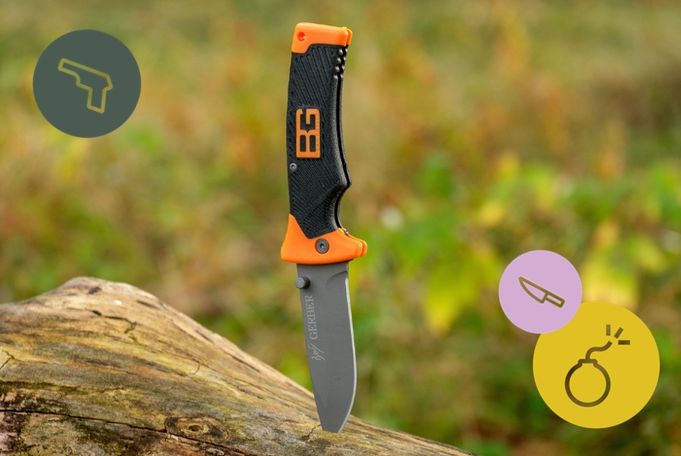
Our top tip for ensuring that ads that include weapons are compliant? Be socially responsible and comply with the Codes. In weapons advertising, the best thing you can do is meet the rules.
It can be acceptable for weapons to feature in marketing communications. However, they must not feature any content inappropriate for the audience, such as excessively graphic or violent imagery, or anything likely to condone or encourage violence or anti-social behaviour. In addition, ads for weapons can only include products that can be legally sold in the UK.
Legality
If you are considering publishing ad for a weapon itself, you should first make sure it’s legal to sell and advertise that weapon in the UK. For example, certain knives and martial arts weaponry are designated as offensive weapons, and therefore cannot be advertised. These include push daggers, belt buckle knives, knuckledusters, flick knives, zombie knives, blowpipes, footclaws and handclaws, to name a few. Certain firearms are also prohibited by law. If in doubt about whether a product is legal in the UK, marketers should seek legal advice.
The ASA upheld a complaint about paid-for ads on Facebook for weapons, including largely illegal firearms, a knuckleduster, and knives and swords with blades over three inches that were significantly restricted by law. The ads, served to an unrestricted adult audience, were found to be socially irresponsible.
Keep children out of harm’s way with careful targeting
The ASA has previously ruled against several ads for knives and weapons for which marketers had not taken the appropriate actions to ensure that children were excluded from their audience.
- An TV ad for Japanese kitchen knives without any age-related scheduling restriction appeared immediately after a ‘U’ rated animated film, when children would have likely been watching.
- Ads for the same brand of kitchen knives appearing on news apps were also found to be irresponsibly targeted.
- A brochure distributed to homes via door drop advertised air guns and knives, which could legally be sold. However, the brochure was not in an addressed envelope and could be viewed by any person at those addresses, including children, so was considered irresponsible and unsuitable in an untargeted medium.
Context is important, and on the other hand, the ASA did not uphold a complaint against an ad for a Call of Duty video game that depicted a soldier holding a gun. The ad was seen by a child on a PlayStation account, but the content was not especially graphic, and there was not any violent imagery, so it was not considered inappropriately targeted.
Do not glamourise weaponry
Marketers should be careful to avoid glamourising weapons or violence in ads. The ASA has ruled against two ads for clothing products that featured guns in this respect. Firstly, an ad for a cycling jersey depicted a model holding a machine gun with his finger on the trigger. The ASA considered the ad had a menacing and aggressive tone and the gun had been included merely as an accessory to make the ad more stylish and edgy. The ASA found the ad’s styling alongside the gun’s incongruous appearance glamorised the gun irresponsibly.
An outwear ad also featured a person in a hooded black coat firing guns repeatedly at a figure in a pink cloak, with slow motion scenes of bullet holes appearing, before revealing it was a mannequin. The ASA considered the presence of three semi-automatic firearms was incongruous and jarring, and in context, the ad glamourised guns and gun violence. The ad was also found to condone and encourage violence against women.
Do not cause unjustified fear or distress
Ads for other products that feature the use of weapons can still breach the ad Codes if they cause unjustified fear or distress to the audience, particularly where weapons are not relevant to the product. A YouTube ad for a VPN service portrayed a realistic depiction of a man tied to a chair, beaten and attacked with weapons, including being stabbed in the leg and tasered around the neck. The overall cinematic presentation of the ad was excessively violent, threatening and distressing, and overshadowed any attempt at humour or the intended commercial message.
Even where weapons are relevant, ads causing fear and distress can still be an issue. A Facebook ad for a hunting mobile app game depicted a first-person view through a sniper, and featured footage of two wild dogs being shot and left in visible distress, as well as a fox being shot dead. Although the marketer said the footage was fictional and featured no real animals, the ASA considered this was not made clear enough and that the ad, which highlighted the animals’ suffering, was likely to cause unjustified distress to viewers.
As you can see, when it comes to weapon ads, the best campaigns are the ones that stay safe and comply with the Codes. However, if you would like an extra view, feel free to contact our helpful Copy Advice team, who can provide guidance on all non-broadcast advertising.
More on
-
Keep up to date
Sign up to our rulings, newsletters and emargoed access for Press. Subscribe now.
