

This report examines how environmental claims are being used in UK online advertising, based on large-scale analysis of ads captured by the ASA between September and November 2025.
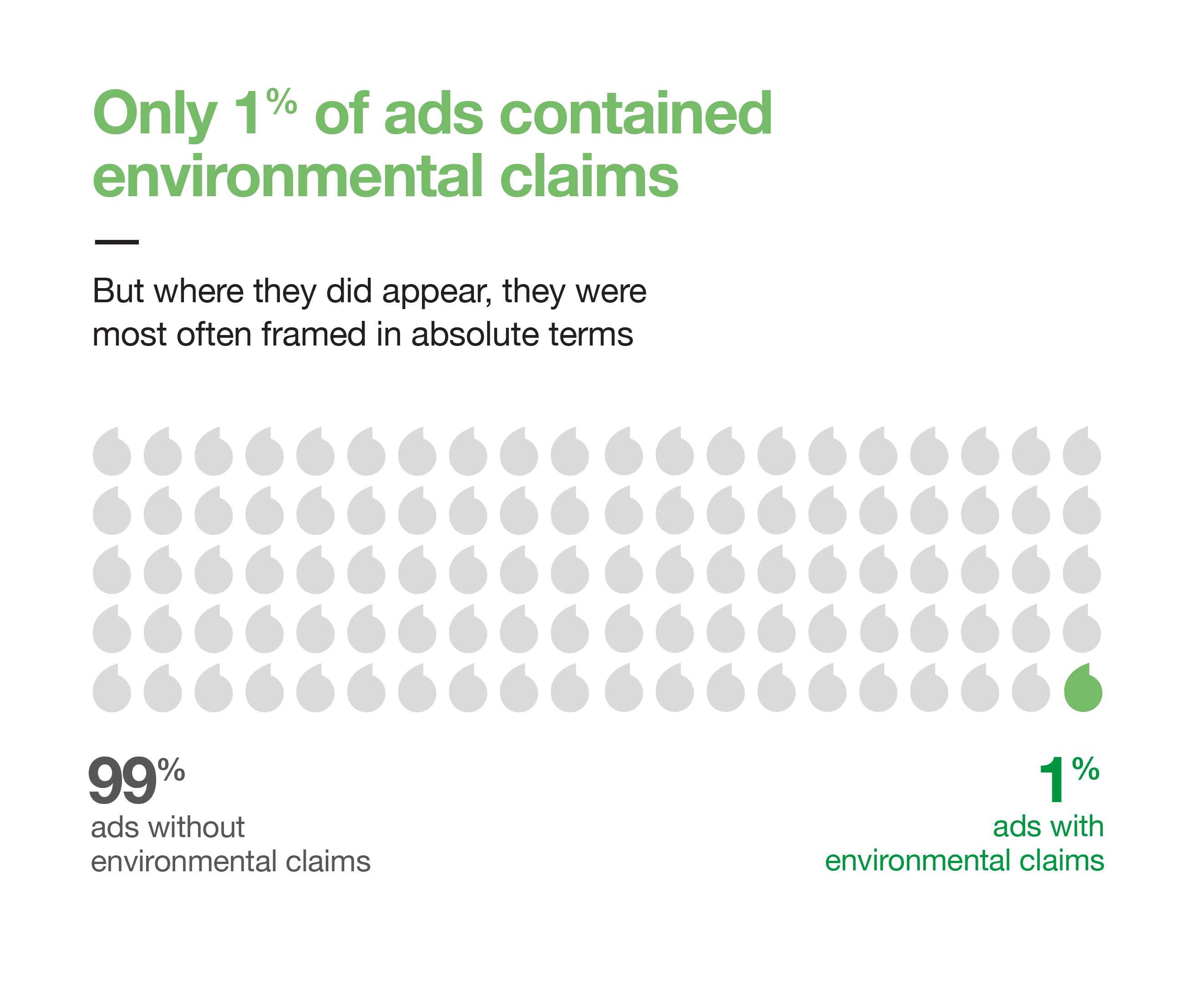
Using our Active Ad Monitoring system, we analysed 7.7 million business-to-consumer ads served to UK consumers across Google search, Google Maps and website display advertising. Around 61,000 ads were identified as containing environmental claims, representing approximately 1% of the ads analysed.
The report does not assess whether individual ads comply with the advertising rules. Instead, it provides a broader snapshot of how environmental claims are being used across online advertising, helping identify patterns, emerging areas of activity and areas where businesses may benefit from further support and guidance.
The findings suggest that environmental claims remain relatively uncommon overall. However, where they do appear, they are often framed in broad or absolute terms such as “eco-friendly”, “sustainable” or “carbon neutral”. Around three-quarters of the environmental claims identified in the study were classified as absolute claims.
Under the CAP Code, absolute environmental claims typically require a high level of substantiation. The findings therefore suggest that potential regulatory risk is shaped less by how often environmental claims appear, and more by how they are framed and understood in context.
The analysis also identified variation across sectors. Environmental claims were concentrated in areas including utilities, food and agriculture, fashion retail, transport, homes and construction, and financial and professional services. The report also highlights emerging areas of activity, including architecture firms promoting “sustainable”, “eco-friendly” and “low carbon” homes.
This work demonstrates the value of analysing advertising at scale. By combining large-scale Active Ad Monitoring, Large Language Models and expert human review, the ASA is able to identify patterns, concentrations and emerging issues that would not be visible through individual complaints alone.
The findings will inform future ASA monitoring, engagement, guidance and enforcement work. CAP will also shortly publish new guidance, Green-speaking with confidence, to help advertisers make clear, evidence-based environmental claims.